As a reminder, I’m setting off to travel from Bangkok to Paris without a plane to promote female entrepreneurship by making portraits of women micro-entrepreneurs and sharing their experiences. I’ll give you the itinerary just below, in case your attention wasn’t at its peak during my interminable explanations of my project over the last few weeks.
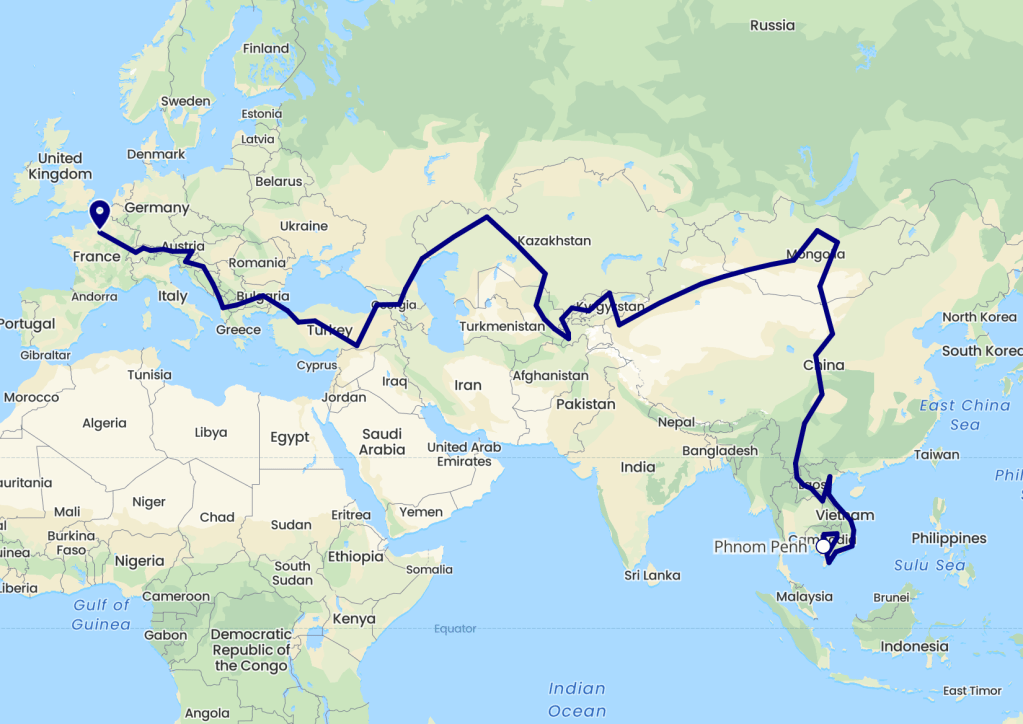
Now that you’ve got the itinerary in mind, we’re going to make one small change: I’m going to leave the Philippines under the guidance of microfinance experts to launch the pilot project (yes, the test project, not the flying object project). The official project will then be launched in Bangkok, where I’ll be meeting microfinance institutes and publishing the first portraits of big bosses, women micro-entrepreneurs. But let’s keep our sights on the preparation for my overland crossing of an entire continent. I never thought I’d say that one day. The maths is pretty simple: I’ve got 30,000 km to cover, alone and unaccompanied, so for the first time in my life I’m going to have to get organised.
Choosing your route
For this part of the trip, backpackers generally decide based on 3 criteria: budget, season, and country appeal. To check these criteria, I used the site tourdumondiste, a goldmine for preparing any aspect of your round-the-world trip. I highly recommend it. There are country information sheets, details of the seasons and the budget per day according to the level of comfort you want. In short, it’s a dream. For my part, as I explained on one of the main pages of the site, I have defined the itinerary according to my associative partners and the NGOs that will enable me to meet micro-entrepreneurs and make their portraits. My initial objective was to go to Bangladesh to discover the microfinance initiatives launched by Yunus, winner of the Nobel Peace Prize in 2006 and creator of the microfinance concept. As the cradle of microfinance is blocked in terms of land accessibility (impossible to enter Myanmar by land, difficult to cross Tibet alone without a very expensive tourist agency, and difficult to cross the Sino-Pakistan border) I had to force myself to follow a certain route upstream. The same goes for Central Asia, with Turkmenistan, where visas are very complicated to get, and Azerbaijan, whose land borders are still closed. So my itinerary ‘mapped itself out’.
Insurance
The most complete I found is the Cap Aventure offer from Chapka. I hesitated between Ava and Chapka for my 6-month world tour insurance. The most important thing for me was the positive feedback from the backpackers I had contacted beforehand. I had the same health insurance when I was abroad in the Middle East for a university exchange, and they were responsive which further motivated my choice. The comparator of the tourdumondiste site confirmed my choice: Chapka covers repatriations, early return, telemedical consultation (very important for me because I cross desert regions), and hospitalization costs among others. I’ll also go surfing in a few places like the Philippines, which is included in the insurance.
Accommodation
My goal being maximum immersion in the culture of the 23 countries crossed, I chose to almost only sleep with locals via the site couchsurfing. The site is free. I will still take youth hostels in certain cities where I plan to stay longer depending on the micro-entrepreneurs I manage to contact there.
Budget
My total budget for 6 months around the world without a plane is €15,000. I will use part to cover travel costs (trains, buses, accommodation, visas, equipment) and the other for financial support to Microfinance Institutes verified, accredited, and recommended by different NGOs. My low cost of living during these 6 months (around €1000/month all-inclusive) is explained by the choice of couchsurfing & inexpensive hostels, the minimal comfort that I want, and other various criteria such as donations of equipment which allowed me to reduce the budget. The composition of the budget is divided between personal savings, donations from those around me (a crowdfunding campaign that I will launch in a few weeks), and sponsors.
Credit cards
As for credit cards, I have 4 main cards in case one of them is stolen, lost, or malfunctions. The 4 banks that I chose are therefore: Revolut (no exchange fees, a must during a world tour), N26 (very easy to use, the interface motivates you to use it as much as Revolut and the exchange fees depending on the transactions are low or non-existent), Lydia (for transfers to French people I meet, and to have a spare card) and La Banque Postale (French account which will allow me to pay urgently but only in an emergency, because the costs are high abroad).
Vaccines
I had to do several vaccines beforehand to travel safely abroad in Southeast Asia, Central Asia, and Central Europe. Therefore, I made hepatitis A, hepatitis B, typhoid, cholera, yellow fever, Japanese encephalitis, and rabies. I also took with me 4 boxes of malaria prevention, for certain parts of the countries that I pass through which are affected (for example Laos).


 Around the World in 80 women
Leave a comment